SIRUI Saturn vs Venus: Which Full-Frame Anamorphic Lens Fits Your Shoot?
Published on: August 05, 2026
Updated on: August 05, 2026
Share
Choosing between two lenses from the same brand is often harder than choosing between two different brands altogether. That's exactly the position many filmmakers find themselves in when comparing the SIRUI Saturn and SIRUI Venus anamorphic lines. Both deliver the same 1.6x squeeze, the same signature blue flares, and the same cinematic 2.4:1 and 2.8:1 aspect ratios — so the decision usually comes down to how and where the lens will actually be used.
This guide breaks down the real differences between the two series, from build material to focal length coverage, so the choice becomes easier.
What Are the Key Differences Between SIRUI Saturn and Venus?
SIRUI Saturn and Venus are both 1.6x full-frame anamorphic lens series with matching aperture and flare characteristics. Saturn uses a lightweight carbon fiber barrel across three focal lengths for mobile rigs, while Venus uses an aluminum alloy housing across six focal lengths for complete studio coverage.
Spec
Saturn
Venus
Squeeze ratio
Constant 1.6x
1.6x (135mm at 1.8x); 2x with optional 1.25x adapter
Focal lengths
35mm / 50mm / 75mm
35mm / 50mm / 75mm / 100mm / 135mm / 150mm
Aperture range
T2.9–T16
T2.9–T16
Barrel material
Carbon fiber front barrel
Aluminum alloy housing
Mount options
E / RF / L / DL / X / Z
E / RF / L / Z
Weight (35mm)
Approx. 415–418g
Approx. 934–971g
Length (35mm)
Approx. 101mm
Approx. 118–121mm
Minimum focus distance
0.9m
0.9m
Lens flare
Blue or neutral flare options
Classic blue flare
Best suited for
Gimbals, drones, handheld run-and-gun
Studio and multi-camera productions
With the shared specs out of the way, it's easier to focus on what actually separates the two series.
What Makes the SIRUI Venus Series Different?
The SIRUI Venus series is a six-lens full-frame anamorphic lineup spanning 35mm to 150mm, built with an aluminum alloy housing for durability. It maintains consistent color tones and squeeze across every focal length, making it well suited to multi-camera, studio-based productions.
The SIRUI Venus full-frame anamorphic lens series is the more complete lineup of the two, spanning six focal lengths from 35mm all the way to 150mm. That range covers everything from wide establishing shots to compressed telephoto portraits, all built around a consistent 1.6x squeeze, matching color tones, and identical gear positions across the set.
This consistency is what makes Venus a strong fit for productions that need to switch lenses mid-shoot without breaking the visual continuity of a scene. The aluminum alloy housing adds durability and a reassuring heft on set, and the 135mm variant steps up to a 1.8x squeeze for a more pronounced anamorphic character on close-ups and portraits. For crews who also want an even stronger squeeze, the optional 1.25x anamorphic adapter pushes the ratio up to 2x, adding more noticeable oval bokeh and stretched backgrounds without switching lenses.
What Makes the SIRUI Saturn Series Different?
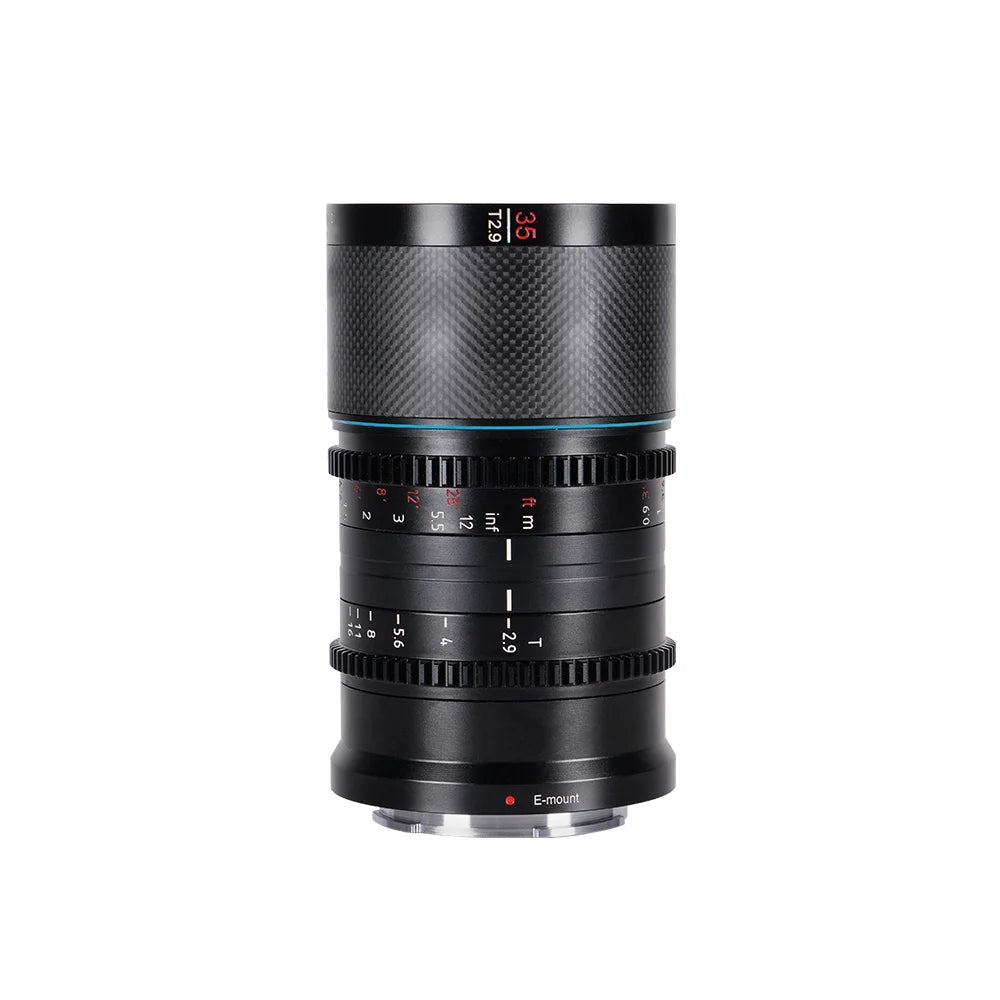
The SIRUI Saturn series prioritizes weight over focal range, using a carbon fiber front barrel that brings the 35mm lens down to roughly 415–418g. It's built for gimbals, drones, and handheld rigs where every gram affects balance and mobility.
The SIRUI Saturn 35mm full-frame carbon fiber anamorphic lens takes a different approach. Instead of prioritizing focal length range, Saturn prioritizes weight. Its carbon fiber front barrel brings the 35mm version down to roughly 415–418g — well under half the weight of the equivalent Venus lens — while still holding the same constant 1.6x squeeze ratio and T2.9 maximum aperture.
That weight difference matters most off a tripod. Saturn was designed with gimbals, handheld stabilizers, FPV drones, and vehicle rigs in mind, where every gram affects balance and battery life. It's also the widest-reaching lens in terms of mount options, available in six configurations including DL and X mounts, which makes it easier to match to a broader range of cinema and mirrorless bodies.
What Did Real-World Testing Reveal Between Saturn and Venus?
In a side-by-side comparison, the tester found both lens sets share strong center sharpness and well-controlled chromatic aberration, but differ in squeeze consistency, color rendering, and bokeh shape. Saturn held a more constant squeeze at close focus, while Venus rendered a noticeably warmer color cast.
Both sets were sharp in the center at T2.9, reaching peak sharpness around T4, with similar pincushion distortion strongest at 35mm. Saturn held a constant 1.6x squeeze from close focus to infinity, while Venus's squeeze shifted slightly at close focus — a subtle change that can affect subject shape in close-up shots.
Color and bokeh were the clearest points of separation: Venus skewed slightly warm and needed a white balance reset when switching lenses, while Saturn showed minimal color shift of its own. At 50mm and 75mm, Saturn also produced a slightly more elongated oval bokeh compared to Venus's rounder shape.
Being over 50% lighter, Saturn was easier to fly on a gimbal, while the heavier Venus set felt more stable on larger cinema cameras without in-body stabilization and was more likely to need a lens support rail. One inconsistency to note: Saturn's filter thread changes by focal length (58mm on the 35mm, 62mm on the 50mm and 75mm), while Venus keeps a consistent 82mm thread throughout.
The flare test itself compared a neutral-coated Saturn lens against a blue-coated Venus lens, so flare color isn't directly comparable — but flare intensity and contrast behavior were similar, with Saturn showing slightly more contrast wash-out under direct light.
What's the Difference Between Anamorphic and Spherical Lenses?
Anamorphic lenses compress the image horizontally in-camera, then stretch it back out in post to create widescreen frames, oval bokeh, and horizontal lens flares. Spherical lenses don't compress the image, so they can't reproduce these same optical characteristics.
Before deciding between Saturn and Venus, it helps to remember why anamorphic lenses are chosen over spherical ones in the first place. Anamorphic optics compress the image horizontally in-camera, which is then stretched back out in post to produce a widescreen frame, oval bokeh, and horizontal lens flares that spherical lenses simply can't replicate. The squeeze ratio — 1.6x on both Saturn and Venus — determines how pronounced that stretch and compression looks in the final image.
Because both series share the same squeeze ratio, aperture range, and minimum focus distance, footage shot on Saturn and Venus lenses intercuts cleanly. This means a production isn't locked into one series exclusively; a Saturn lens can be brought in for a drone shot in the middle of a scene built primarily around Venus primes, without a visible mismatch in look.
SIRUI Saturn vs Venus: Which One Should You Choose?
Choose Saturn for lightweight, mobile shooting on gimbals, drones, or handheld rigs. Choose Venus for studio and narrative productions that need a complete, consistent focal length family from wide to telephoto. Many crews use both series together.
For solo shooters, run-and-gun documentary work, or anyone mounting a lens on a gimbal or drone, the SIRUI Saturn series is the more practical choice. The carbon fiber build keeps rigs balanced and lightweight, and the six mount options make it easy to fit existing gear.
For narrative productions, studio setups, or any project that benefits from a complete focal length family — from wide 35mm coverage through a compressed 150mm telephoto — the SIRUI Venus series offers more flexibility to build out a full anamorphic kit without switching brands or aesthetics partway through.
Many working filmmakers end up owning lenses from both series: Venus primes for the core of a shoot, and a Saturn lens on standby for the shots that need to move.
Frequently Asked Questions
Are SIRUI Saturn and Venus lenses compatible with the same camera?
Both series are available across overlapping mounts — E, RF, L, and Z — so most full-frame mirrorless cameras can use either line. Saturn additionally offers DL and X mount options.
Can I mix Saturn and Venus lenses in the same production?
Yes. Since both share the same 1.6x squeeze ratio, T2.9–T16 aperture range, and blue flare characteristics, footage from the two series matches well when intercut.
Which SIRUI anamorphic lens is lighter?
The Saturn 35mm, thanks to its carbon fiber front barrel, weighs roughly 415–418g — significantly lighter than the Venus 35mm at approximately 934–971g depending on mount.
Does the Venus series offer a stronger anamorphic look than Saturn?
The core lineups share the same 1.6x squeeze. The Venus 135mm steps up to 1.8x, and either series can reach a 2x squeeze with the optional 1.25x anamorphic adapter.