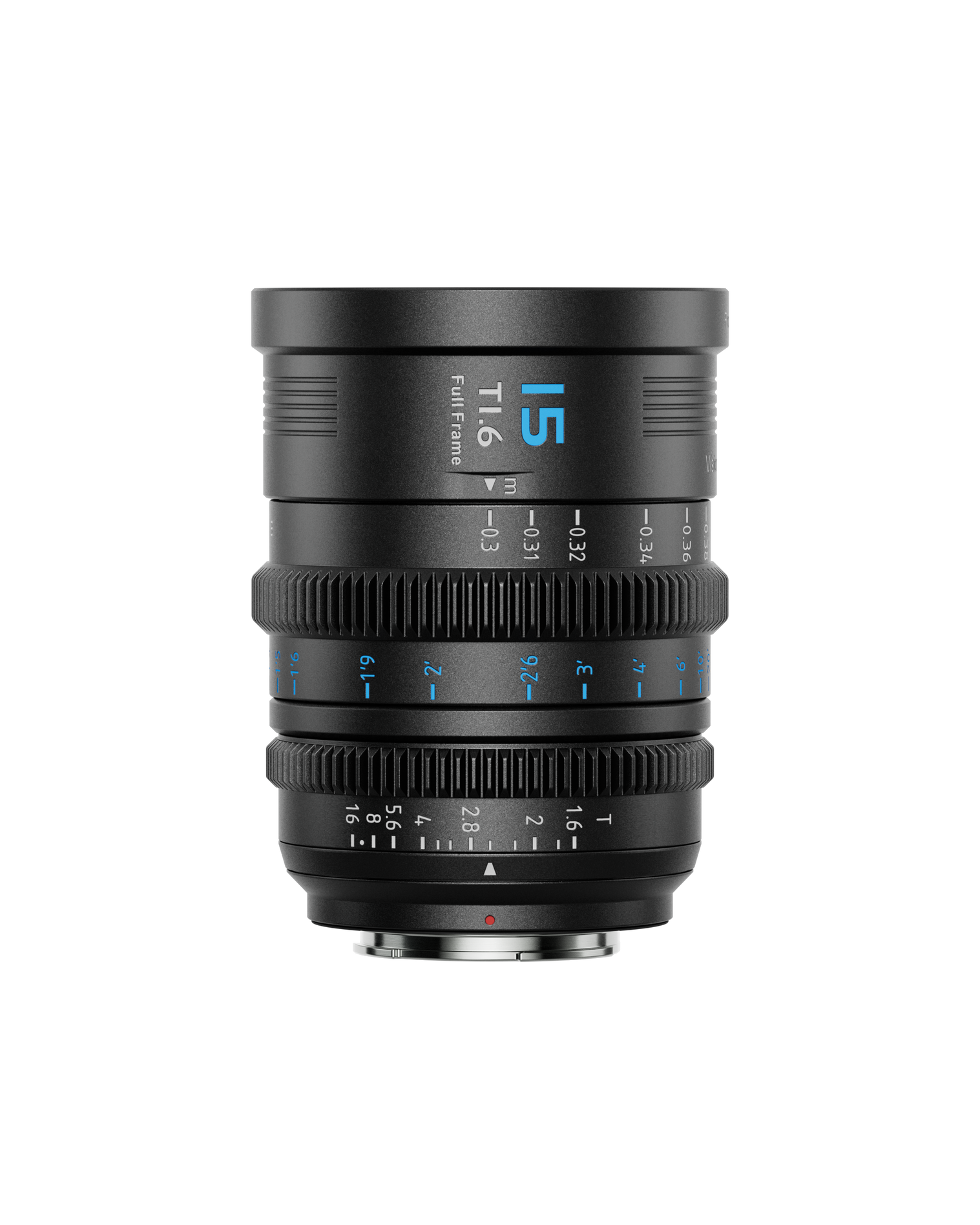
SIRUI Vision Prime 15mm T1.6 Review: The Wide-Angle Cine Lens That Surprised Us
Published on: July 29, 2026
Updated on: July 29, 2026
Share
When SIRUI expanded its Vision Prime cinema lens series with three new focal lengths — a 15mm, a 75mm, and a 150mm — the update didn't look like a dramatic redesign on paper. But for one reviewer testing the new glass alongside the original 24mm, 35mm, and 50mm kit, the 15mm turned out to be the lens that left the strongest impression, and not for the reasons expected going in.
Expanding the Vision Prime Lineup
The original Vision Prime kit — 24mm, 35mm, and 50mm — launched as a roughly $1,499 starter set for filmmakers, built around a standout feature: an interchangeable mount system. Out of the box the lenses ship in Sony E, but they can be swapped to Nikon Z, Canon RF, or Leica L, meaning a shift to a different camera body doesn't mean starting a lens collection from scratch.
With the addition of the 15mm ($649), 75mm ($649), and 150mm ($649) — also available as a three-lens bundle for $1,899 — the series now spans six focal lengths, from ultra-wide to long telephoto. For anyone already running the original three, the new set doesn't change the look of the system; it simply fills in the range. The tester received the 15mm and 75mm for review, chosen specifically because they filled the two gaps felt most in a working kit: a super-wide option and a slightly longer, more compressed focal length for tighter framing.
Hands-On with the 15mm T1.6
The 15mm is a T1.6, with a minimum focusing distance of about 0.3 meters — roughly a foot — and a 77mm front filter thread. In practice, that combination opened up two very different shooting scenarios during testing.
Out in the field, the lens was used for a low-angle, wide shot of a pickup truck parked in open grassland, shot on a Nikon body. Even with the sky and horizon dominating most of the frame and the sun sitting low, camera lines stayed straight — no obvious barrel distortion pulling at the edges of the frame — and the flare from the low sun was present but restrained rather than overwhelming.
On the other end of the distance scale, the tester also used the 15mm at its closest focusing point — 0.3 meters — to shoot a small tabletop figure alongside a color-calibration chart. At that distance, and wide open at T1.6, the background fell away into soft blur while the subject stayed crisp, a look not typically expected from a lens this wide.
Distortion and Focus Breathing at 15mm
Ultra-wide lenses often come with tradeoffs — heavy distortion toward the edges, or visible focus breathing as the lens racks focus. The 15mm's performance on both fronts was described as one of the bigger surprises of the review. Distortion was minimal to the point of being hard to detect, and focus breathing was similarly well controlled — noticeable only if searched for closely, and largely absent in normal shooting.
That combination makes the 15mm well suited to interiors, room shots, and any scene where showing the surrounding environment matters as much as the subject. Its relatively close focusing distance also means a subject can be framed tightly while the environment around it stays visible in the shot.
*Photo By Will Hall
Wide Angle vs Telephoto: Where the 15mm Fits
Paired with the rest of the Vision Prime range, the 15mm's role becomes clearer in context. The 24mm, 35mm, and 50mm cover the focal lengths used most often day to day, while the 75mm adds compression for portraits and detail work, and the 150mm extends reach for more specialized shots. The 15mm sits at the wide end of that spread — the lens reached for when a scene calls for an establishing shot, a full room, or a large environment rather than a tight, isolated subject.
Overall image quality across both new lenses matched what the original Vision Prime set delivered: clean, sharp, and closer to clinical than characterful. Chromatic aberration can still appear in high-contrast, out-of-focus areas at wide apertures, and lens flares stay subtle rather than dramatic — in other words, these aren't lenses built for heavy vintage character, but for controlled, modern cinema images.
Build Quality and Everyday Handling
Across the lineup, the 15mm and 75mm carry the same solid metal construction as the original three lenses, available in metal gray or black finishes. Focus and aperture rings are chunky, smooth, and — notably — positioned identically across the different focal lengths, so a follow-focus and aperture control rig set up for one lens doesn't need to be readjusted when swapping to another. The one variable is the distance to the front of the lens, which can matter slightly for rod-mounted accessories like a matte box.
FAQ
What is the aperture of the SIRUI Vision Prime 15mm? The 15mm is a T1.6, making it the fastest wide-angle option in the Vision Prime lineup.
Does the 15mm suffer from distortion at this focal length? In testing, distortion was minimal even at 15mm, with straight lines holding up well toward the edges of the frame.
Can the Vision Prime 15mm be used across different camera systems? Yes. Like the rest of the Vision Prime series, it uses an interchangeable mount design and ships in Sony E, with Nikon Z, Canon RF, and Leica L mount options available.
What is the minimum focusing distance of the 15mm? Approximately 0.3 meters, allowing for close subject framing while still showing the surrounding environment.
SIRUI Vision Prime 15/75/150mm T1.4
Full-frame cine lens set covering ultra-wide, portrait, and macro shooting, with a user-interchangeable L/RF/Z mount system for fast switching between camera bodies.